Enter the mating date to calculate the expected delivery date and key milestones.
1. Signs of Approaching Labor in the Dog
Many novice breeders, fearing that they will miss their female's birth, do not sleep at night and are afraid to jump out even for shopping. The other extreme is, on the contrary, those who do not worry and cheerfully leave home for the whole day in the blissful belief that "nature will help itself". It is hardly necessary to emphasize that neither of these procedures is correct. If we start from the basic assumption that pregnancy lasts on average 63 days, but can range from 58 to 68 days, it is necessary to pay close attention to the female at this time. The signs of approaching birth are usually so pronounced, at least in first-time mothers, that even a beginner will notice them in time. Often as early as 12 to 24 hours before the birth itself, the female begins to be strikingly restless, moves from place to place, stops accepting food including the greatest treats, and occasionally breathes rapidly. At this time, the body temperature of the female also decreases significantly. If the owner knows what body temperature his female normally has (in dogs there is quite a large range, given as 38.5 - 39.4 °C), you will easily register its significant reduction, on average to 37.2 - 37.5 °C. This clearly signals that labor is at the door. However, if your female is not used to measuring temperature in the rectum, rather do not stress her at this time and pay all the more attention to changes in her behavior.
Key Labor Signal:
A drop in the female's body temperature to 37.2–37.5 °C usually occurs 12–24 hours before birth.
After a few hours, sometimes even after a whole day, the "restless phase" is followed by the birth itself. The breeder should unconditionally be present at this, whether his assistance is needed or not. After all, even the most experienced breeder cannot know this safely in advance. By this we do not want to scare you in any way, most births proceed completely normally, nevertheless a certain vigilance is always in place. It is also not a bad idea to agree in advance with your veterinarian whether he would be willing to step in in case of complications or who you should turn to in his absence. Especially breeders of breeds such as English Bulldogs, French Bulldogs, Boston Terriers, etc., where the risk is greater, should definitely not forget this. It is with them that the need to perform a C-section arises more often than with others, and that is of course a matter for an expert.
2. Course of Labor and Breeder Assistance
On the other hand, we would like to warn against excessive nervousness or haste on the part of the breeder. Especially the birth of the first puppy usually takes longer than we would wish and imagine. Even though it is certainly not easy for an inexperienced breeder to see a female suffer for an hour or more and the effort to help is understandable, it would be an unforgivable mistake to transport her to a veterinary clinic at this moment. Generally, it is necessary to be guided by the fact that intervals up to two hours (although they are usually much shorter, often for example only ten minutes) are within the norm and it is not necessary to panic. At most, to calm your soul in these moments, you can consult with an experienced breeder. If you know about yourself that you are of a weaker nature, find it hard to decide in critical situations or have a tendency to act rashly, rather invite an experienced breeder for the entire birth. Your female probably won't need it, but you will calm down and won't transfer your nervousness to her.
The actual birth announces itself with intense contractions, when the female usually lies on her side, or gets up. Before the first puppy sees the light of day, it can take half an hour, an hour, but also two hours. The others usually follow faster, roughly after half an hour, sometimes even after a few minutes. The total duration of birth depends primarily on the size of the litter. Everything can be over in two hours, but also in 12 hours and it is still a normal, physiological birth. A frequently discussed question is the need for the breeder's help during birth. Again, we must follow the behavior of our female. If she acts confidently during birth, frees the newborn puppies from fetal membranes and licks them, everything is in the best order and the breeder can remain in the role of an observer, or only tie off and cut the umbilical cord (at a distance of about 2 cm from the puppy's belly). If the female shows no interest in the puppies, is restless, nervous or weakened, we remove the fetal membrane from the puppy ourselves (with sterile scissors), carefully wipe the nose, oral cavity and then the puppy's body with a clean cloth or cellulose. And again we must not forget to cut the umbilical cord. Then, depending on the situation, we either place the puppy at the female's teats, or for the time being place it in a box with a hot water bottle or a bottle of warm water wrapped in cloth. A high temperature of the environment in which the puppy lives for the first hours and days after birth is essential, as newborn puppies cannot yet create heat themselves and are at risk of hypothermia. Therefore, we should try to maintain the environmental temperature during the first ten days at about 30 °C.
Whelping Box Temperature: Maintain around 30 °C during the first 10 days after birth, newborn puppies do not yet have developed thermoregulation!
3. End of Delivery, Cleaning, and the Importance of Colostrum
"So we have it happily behind us," sighs the new breeder, lovingly looking at the rolling ball of newborn puppies. Poor guy doesn't know that he has very little behind him and that the biggest piece of work is yet waiting for him. Not to mention that a seemingly finished birth in reality does not have to be finished at all, so even that "behind us" is questionable. Quite often it happens that there are say six puppies in the world, the belly drops, the female calms down, or even falls asleep - and after a few hours another puppy appears under her. If this final interval is not longer than six hours, even the last addition can be fine. In any case, you won't spoil anything if, after the end of the birth, you take the female outside so she can relieve herself. If any fetus remained in her, movement can help its way into the world. And if not, the female needs to relieve herself anyway. From the moment puppies are born, however, it is necessary to carefully wipe the female's belly with cotton or a cloth soaked in boric water after every trip outside, especially in an urban environment.
In the first hours after birth, it is necessary to carefully clean the dirty whelping box and the female, give her water and, if she has an appetite, light food. Mostly, however, the mother has no thought of food and wants only one thing from us: to leave her in peace. We will continue to observe her to verify that she lacks nothing and can take care of the puppies, but we will avoid unnecessary "organizing", inspecting and moving puppies, as well as showing them off to acquaintances.
Usually already before birth or during it, the mammary gland begins to produce milk. In the first two days it has a very specific composition and contains vital protective substances for the young that help protect them from possible infections. Roughly after two days, the production of this precious fluid called colostrum ends and the female nurses the puppies with normal milk, which, however, differs quite significantly in its composition from that which we normally buy in the shop, especially by a higher proportion of protein and fat, but also minerals and vitamins.
4. Substitute Feeding of Puppies and Nutrition of the Lactating Female
Just as for human babies, for dog ones too it is ideal when their mother has enough milk and can nurse them. Of course, this saves the breeder many problems whose existence he often has no idea about, and allows him to experience the first days and weeks of puppies in peace. However, it can happen that the female has no milk or has little of it. Soon we will recognize it even with lay eyes by the behavior of the puppies: they will be restless, will vocalize loudly more and more often, will not gain weight or will even visibly start losing weight. In such a case, we will be forced whether we want to or not to resort to artificial nutrition. Solace can be that unlike in times recently past, when breeders were forced to solve such cases on their own and complicatedly assemble substitute feed rations, today it is after all simpler. Renowned dog food manufacturers offer very high quality powdered milk for puppies, where a constant ideal composition is guaranteed. Nevertheless, raising puppies without a mother is very demanding on time and patience of the breeder. At first it is necessary to feed every three hours, only after 10 - 14 days can we extend the interval to four hours and after another week gradually transition to feeding solid food.
Increase of Feed Rations for Female After Birth:
• 1st–2nd week after birth: 2 to 3 times normal ration
• 3rd–4th week after birth: 4 times or more normal feed ration
Even if it tempts to turn all attention after birth to the puppies, we definitely must not forget about the dog mommy. In the period after birth, her organism is exposed to extreme load and also requires an extraordinary amount of food. Generally it can be said that in the first two weeks after birth the female should accept double to triple amount of food compared to normal, in the next two weeks the requirement then rises four times or more. Only after weaning do we gradually reduce the feed ration to normal. There is absolutely no need to fear that the female would get fat, mostly the exact opposite is true. If we manage that the female has approximately the same weight after weaning the puppies as she had before mating, we can congratulate ourselves. With a larger number of puppies and higher milk production of the female, however, this is a difficult target to achieve even with multiple rations of food.
5. Composition of Food and Risk of Postpartum Eclampsia
It is hardly necessary to emphasize that the food of a lactating female must be exceptionally high quality. If we normally feed with ready industrially produced feeds, then during pregnancy we can serve special mixtures for lactating females, which are energetically richer. If we feed with home-prepared food, we must pay attention to its balance and it is recommended to increase the proportion of liquids in the food (adding a larger amount of meat broth). Milk, which is still occasionally recommended, is not the most suitable because it often causes diarrhea. Cottage cheese, cheeses or yogurts are usually more acceptable for the female. It is important to divide the feed ration into about four smaller portions. In the "classic" way of feeding, most experts recommend giving calcium and phosphorus preparations in a suitable ratio in the first weeks after birth, or even before it. You will do best if you consult with your veterinarian.
A properly composed feed ration including the addition of mineral substances can help you avoid the threat haunting as a nightmare many breeders: postpartum eclampsia. The condition designated in this way affects especially younger females of smaller breeds, but breeders of others cannot be sure before it either. It appears suddenly and the symptoms are usually very distinct: restlessness, whining, accelerated shallow breathing, jerky movements of limbs and body temperature over 40 °C. After a few minutes, severe cramps with the head thrown back occur. In such a moment it is necessary to act quickly. Because one of the main causes of postpartum eclampsia is an acute lack of calcium, it is necessary to immediately separate the puppies, place a cold wet compress on the female's belly and seek a veterinarian as quickly as possible. A calcium injection usually brings immediate relief and a profound improvement in the female's condition after a few hours. Only a veterinarian can decide on further action and when it will be possible to give the puppies back to the female based on an individual assessment of the female. Even if postpartum eclampsia does not occur at all in most females, it is necessary for every, even beginner breeder to know about it and be able to react promptly. If expert help were not immediately provided to the female, it would mean an inevitable end.
WARNING: Postpartum Eclampsia (Acute Calcium Deficiency)
Symptoms: Restlessness, whining, body temperature over 40 °C, severe cramps with head thrown back. First Aid: Separate puppies immediately, cold compress on the belly and seek a vet immediately for a calcium injection!
Save emergency contact for veterinarian:
Saved Contact:
6. Puppy Growth, Eye Opening, and Supplemental Feeding
"Small children, small worries, big children, big worries," we like to say about our offspring. It is similar with puppies. Assuming that everything is in order and no complications occur (these are, however, quite common; in professional literature it is stated that the average mortality of newborn puppies is up to 25%), there is actually not much work with puppies in the first days of life. The female takes care of them, feeds them, massages their bellies, and immediately removes all smelly remains. In such an ideal case, the breeder is condemned to the role of a passive observer, a heater (we have already said that newborn puppies need a high ambient temperature, preferably around 30 degrees Celsius), and a feeder of their female, who can consume an incredible amount of food at this time.
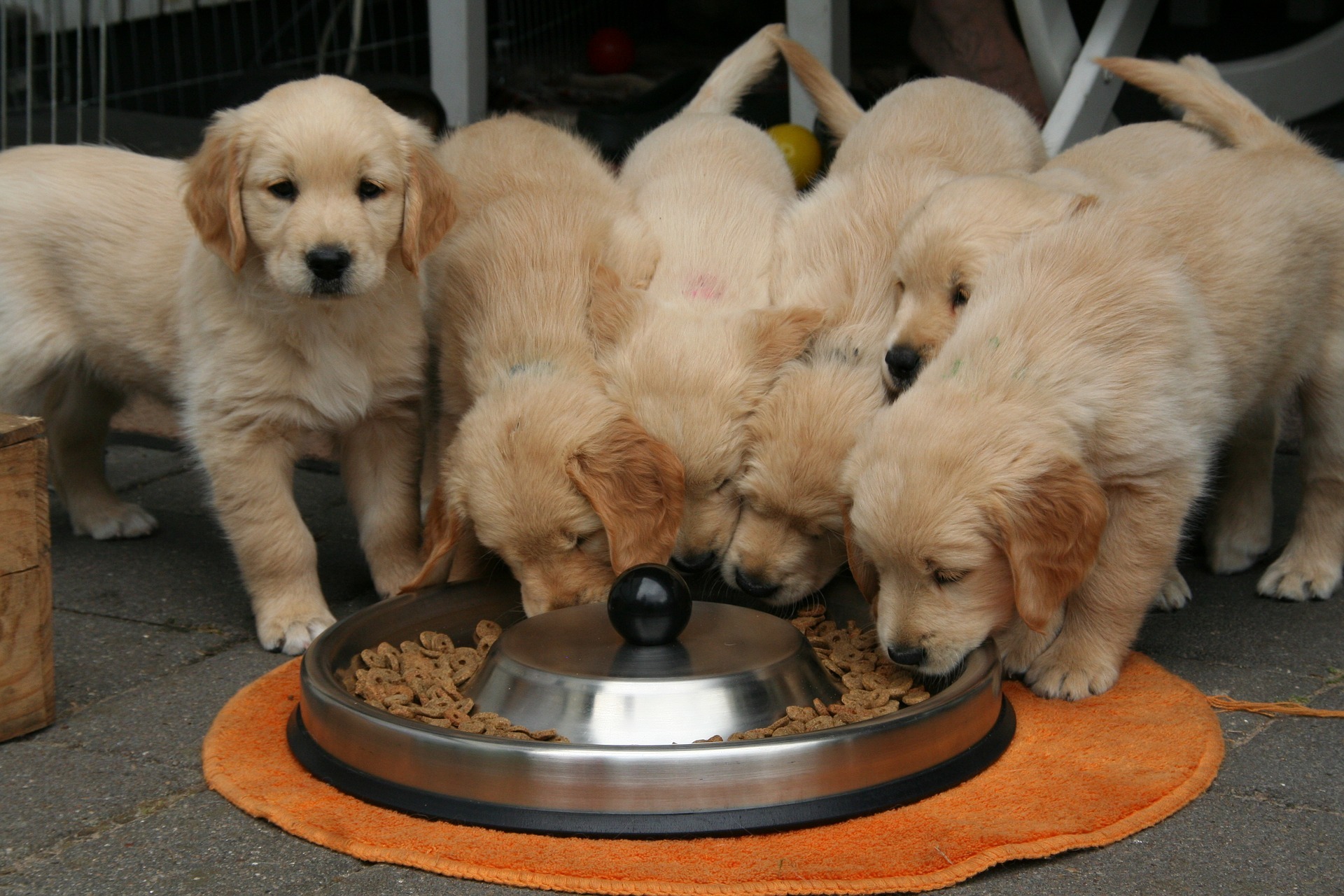
However, this idyll does not last long. The puppies are growing like weeds. Around the tenth day, their eyes begin to open, and at the same time the ear canal opens, so the little dogs begin to perceive the world not only by smell and touch as before, but also by sight and hearing. Slowly they begin to take an interest in their surroundings, try to stand up, and around the third week we will enthusiastically observe the first attempts at play. We don't even realize that with the increasing activity of the puppies, our period of—even if only relative—peace ends. The mother will run away from her children more and more often because their growing milk teeth are as sharp as needles and hurt her sensitive teats. It is high time for us to start transitioning the little ones to normal solid food. It is impossible to set an exact date when it is necessary to start supplemental feeding. Some females have plenty of milk and are patient, in which case they can nurse for a month or longer (however, there is a danger here, especially in lymphatic breeds, that the belly with teats will remain pulled down forever). Another has less milk, so the puppies soon become restless, whine, and do not gain weight. On average, however, we should start gradual supplemental feeding roughly from the third week of the puppies' age. The simplest and health-wise optimal way is to gradually transition the puppies to commercially produced milk and porridge designed specifically for the weaning period. If we choose products from a reputable company, the puppies will be provided with an optimal supply of all necessary substances. Since we do not know how our offspring will be fed by their future owner, we should later gradually accustom them to accepting a wide variety of foods (of course within the principles of healthy canine nutrition). We should feed puppy kibble (that for adult dogs would definitely not be enough for them during the period of rapid growth), but also cooked beef, lamb, or poultry cut into small pieces with rice or flakes and grated carrot, pieces of not too salty cheese, cottage cheese, egg yolks. Components of animal origin should significantly predominate over plant components in puppies.
7. Transition to Solid Food and Psychological Development
We cannot expect puppies to know what is expected of them right after the first presentation of the bowl, when until now they only knew "sweet milk from the udder". It is much more likely that they will trample the first few portions and spread them all over their coats. But we will not be discouraged, we will wipe the puppies with a damp cloth, clean up the whole mess, and try again after a few hours. We can help by dipping our fingers into the porridge and letting the little greedy ones lick them. It takes a little patience and definitely not giving up after the first unsuccessful attempt—sooner or later every puppy will learn to accept solid food. Once the whole litter manages it with porridge, we can transition to the mixtures described above with minced or finely chopped meat, gradually serving larger and larger pieces. Puppies need to exercise their chewing muscles, and continuous feeding of mushy food is definitely not suitable (we can return to it again only with old dogs who have lost most of their teeth).
With weaning puppies comes another unpleasantness that particularly affects breeders who are reliant only on a city apartment. As soon as the puppies stop feeding mainly on mother's milk, most females stop "cleaning up" after them. Only now do we realize how easy a life we had until now. Puppies poop and pee like crazy, and what's more, they don't mind at all stepping in it and spreading dirt all over the place. The time comes when it is best, if it is the warm season, to gradually accustom the little restless ones to staying outside during the day, preferably in a sufficiently spacious enclosure with the possibility of free movement in the garden if we are present. Even in an apartment, however, we should designate a larger space for puppies in a bright, sunny, and well-ventilated place. Bathrooms or various windowless closets are completely unsuitable! Even the most tolerant dog lover usually soon discovers that allowing puppies to run freely around the apartment (which is what they would most like to do) means its actual destruction. Equally important as the healthy physical development of puppies, however, is their psychological development from one month of age.
1 / 7
Privacy Settings (Cookies)
This website uses cookies (Google Analytics) to analyze web traffic. By using this website, you agree to their use.